
LED Stadium Lighting: Complete Guide (2026)
Written by: Harolux Engineering Team | Updated: May 2026 | Reviewed by: LED Lighting Specialists with 15+ Years Experience
Quick Answer: LED stadium lighting delivers 60-70% energy savings compared to metal halide systems, with 50,000+ hour lifespan and 140+ lumens/watt efficacy. For a standard soccer field requiring 500 lux, you need approximately 42-48 fixtures (600W each) costing $38,000+ annually in energy savings.
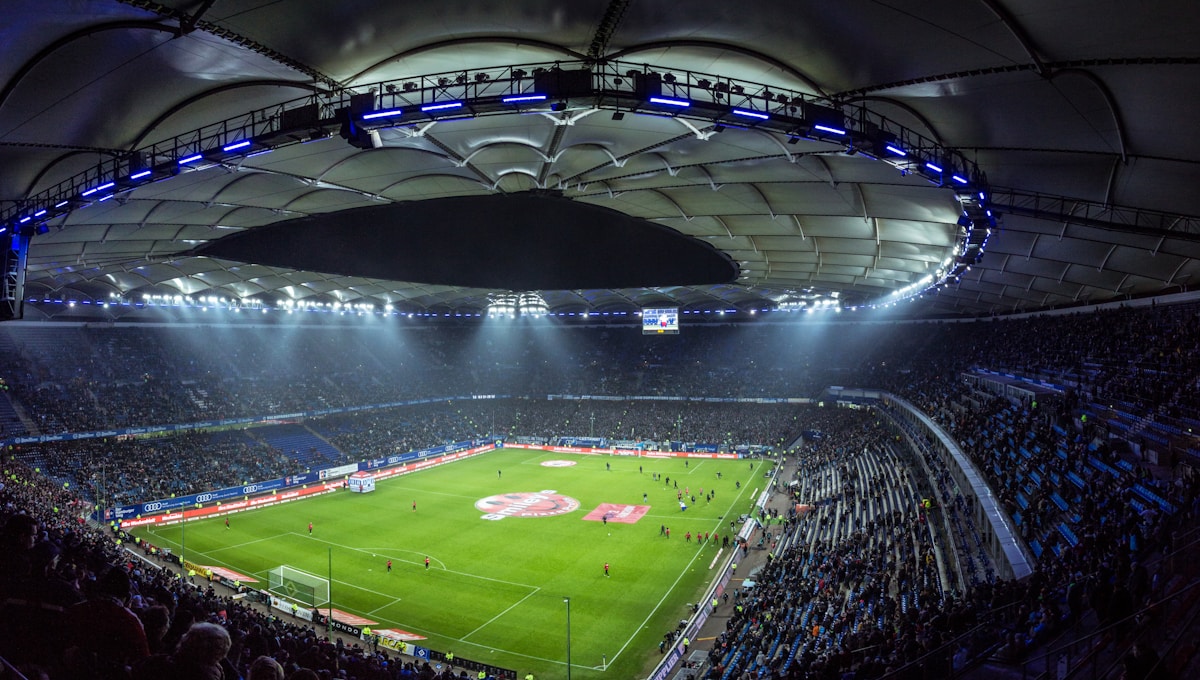
Modern LED stadium lighting provides uniform, flicker-free illumination for professional sports broadcasting.
Table of Contents
- Why LED Stadium Lights Outperform Traditional Lighting
- Stadium Lighting Standards by Sport Level
- How to Calculate Stadium Lighting Requirements
- LED Stadium Light Specifications & Selection Guide
- Cost Analysis: LED vs Metal Halide
- Installation Best Practices
- Frequently Asked Questions
- Product Recommendation
1. Why LED Stadium Lights Outperform Traditional Lighting
LED stadium lights have become the standard for sports field illumination, replacing metal halide and halogen systems across professional, collegiate, and recreational facilities. Here’s why:
Energy Efficiency: 140+ Lumens Per Watt
LED stadium fixtures deliver 140-160 lumens per watt, compared to metal halide’s 80-100 LPW. This translates to:
- 60% lower energy consumption for equivalent brightness
- $38,000+ annual savings for a typical stadium (based on 150,000W to 65,000W reduction)
- Reduced cooling load – LEDs generate less heat
LED stadium lighting uses 60% less energy while delivering superior brightness.
Lifespan: 50,000+ Hours vs 10,000 Hours
| Lighting Type | Rated Lifespan | Replacement Frequency |
|---|---|---|
| Metal Halide | 10,000-15,000 hrs | Every 2-3 years |
| High-Pressure Sodium | 15,000-24,000 hrs | Every 3-4 years |
| LED Stadium | 50,000-100,000 hrs | Every 15-20 years |
Key Insight: LED fixtures eliminate the labor costs and event disruptions of frequent bulb replacements.
Instant On/Off & Controllability
LED stadium lights reach full brightness in 0.1 seconds, eliminating the 5-10 minute warm-up time of metal halide. This enables:
- Dynamic lighting for multi-purpose events
- Instant blackout effects for entertainment
- Automated scheduling with photocell/DMX controls
Superior Light Quality for Broadcasting
Modern LED stadium lights feature:
- CRI >80 for accurate color rendering
- Flicker-free operation for slow-motion footage
- 4000K-5700K color temperature matching broadcast standards
2. Stadium Lighting Standards by Sport Level
Professional sports organizations and broadcasting companies require specific illuminance levels:
Illuminance Requirements Table
| Sport Level | Vertical Lux | Horizontal Lux | Uniformity Ratio |
|---|---|---|---|
| International Competition (FIFA/UEFA) | 1,500-2,000 | 2,000-2,500 | < 1.3 |
| National Competition (MLS/NFL) | 1,000-1,500 | 1,500-2,000 | < 1.5 |
| Regional/Collegiate | 500-750 | 750-1,000 | < 1.7 |
| Training/Recreational | 200-300 | 300-500 | < 2.0 |
Source: IESNA (Illuminating Engineering Society) Sports Lighting Standards
Sport-Specific Requirements
Football/Soccer Stadium Lighting:
- Standard field: 105m × 68m = 7,140 m²
- Professional match: 2,000 lux = 14,280,000 lumens required
- Training session: 300 lux = 2,142,000 lumens required
Baseball Field Lighting:
- Infield: 1,000+ lux for professional games
- Outfield: 700-1,000 lux
- Batting practice: 300-500 lux
Tennis Court Lighting:
- Professional: 750-1,000 lux
- Recreational: 300-500 lux
- Uniformity critical for ball visibility
Track & Field:
- Sprint lanes: 500-750 lux
- Field events: 300-500 lux
- Broadcast quality: 1,000+ lux
3. How to Calculate Stadium Lighting Requirements
Follow this step-by-step calculation to determine your lighting needs:
Step 1: Measure Field Area
Calculate your field dimensions:
- Soccer: 105m × 68m = 7,140 m²
- Football (American): 110m × 49m = 5,390 m²
- Baseball (full field): ~10,000 m²
Step 2: Determine Target Lux Level
Based on your sport level (see Section 2):
- Professional: 2,000 lux
- Regional: 750 lux
- Training: 300 lux
Step 3: Calculate Total Lumens Required
Formula: Field Area × Target Lux = Total Lumens
Example: Soccer field at 500 lux
7,140 m² × 500 lux = 3,570,000 lumens
Step 4: Select Fixture Wattage & Output
For 140 LPW efficacy:
- 300W fixture = 42,000 lumens
- 600W fixture = 84,000 lumens
- 1200W fixture = 168,000 lumens
Step 5: Calculate Number of Fixtures
Formula: Total Lumens ÷ Fixture Lumens = Fixture Count
Example: Using 600W fixtures
3,570,000 ÷ 84,000 = 42.5 fixtures
Add 10-15% buffer for uniformity: 46-48 fixtures
Step 6: Determine Pole Configuration
| Field Size | Recommended Poles | Pole Height |
|---|---|---|
| Small (training) | 4 poles | 12-15m |
| Medium (regional) | 6 poles | 15-20m |
| Large (professional) | 8-12 poles | 20-25m |
4. LED Stadium Light Specifications & Selection Guide
Key Specifications to Consider
Wattage Options:
- 300W-600W: Small fields, training facilities
- 600W-900W: Regional competition, collegiate
- 900W-1200W: Professional stadiums, broadcast quality
Color Temperature:
- 3000K: Warm white, comfortable for spectators
- 4000K: Neutral white, balanced for general use
- 5000K-5700K: Cool white, optimal for broadcast cameras
Beam Angle:
- 60°-90°: Wide distribution for uniform coverage
- 30°-60°: Narrow beam for long throw distances
Certifications:
- UL/ETL: North American safety certification
- DLC: Efficiency qualification for utility rebates
- IP65/IP66: Weatherproof for outdoor installation
Harolux SS-SR04 LED Stadium Light Series
Product Highlights:
- Wattage: 300W to 1,200W (selectable)
- Efficacy: 140 lumens/watt
- Color Temperature: 3000K/4000K/5000K selectable
- IP65 waterproof rating
- UL/ETL/DLC certified
- 5-year warranty
Applications:
- Football/soccer stadiums
- Baseball fields
- Tennis courts
- Track & field facilities
- Multi-purpose sports complexes
View Harolux SS-SR04 LED Stadium Lights →
5. Cost Analysis: LED vs Metal Halide
Energy Cost Comparison (Standard Stadium)
| Metric | Metal Halide | LED Stadium | Savings |
|---|---|---|---|
| Total Wattage | 150,000W | 65,000W | 57% reduction |
| Annual Hours | 3,000 hrs | 3,000 hrs | – |
| Energy Rate | $0.12/kWh | $0.12/kWh | – |
| Annual Energy Cost | $54,000 | $23,400 | $30,600 |
Maintenance Cost Comparison
| Item | Metal Halide | LED Stadium |
|---|---|---|
| Bulb Replacement | $5,000/year | $0 |
| Labor Costs | $3,000/year | $500/year |
| Cleaning | $500/year | $500/year |
| Annual Maintenance | $8,500 | $1,000 |
Total 5-Year Operating Cost
| System | Energy | Maintenance | Total 5-Year |
|---|---|---|---|
| Metal Halide | $270,000 | $42,500 | $312,500 |
| LED Stadium | $117,000 | $5,000 | $122,000 |
Total 5-Year Savings: $190,500
ROI Calculation
- LED stadium lighting upgrade cost: ~$150,000-200,000
- Annual savings: $38,100
- Payback period: 4-5 years
- 20-year total savings: $500,000+
6. Installation Best Practices
Pole Placement & Aiming
Optimal Aiming Angles:
- 15-25° downward tilt for uniform coverage
- Avoid angles >30° to minimize glare
Fixture Distribution:
- Overlap coverage zones by 10-15%
- Position fixtures to eliminate dark spots
- Consider spectator sight lines
Electrical Requirements
Power Supply:
- 208V-480V three-phase for large installations
- 120V-277V for smaller facilities
- Dedicated circuits per pole group
Control Systems:
- 0-10V dimming for energy management
- DMX512 for entertainment lighting
- Photocell for automated on/off
Safety Considerations
- Ensure proper pole mounting (wind load rating)
- Use weatherproof junction boxes
- Install surge protection
- Maintain clearance from player areas
- Follow local electrical codes
7. Frequently Asked Questions
Q: How long do LED stadium lights last?
A: LED stadium lights have a rated lifespan of 50,000-100,000 hours. At typical usage of 3,000 hours per year (8 hours/day, 375 days), this translates to 17-33 years before replacement.
Q: Are LED stadium lights suitable for HDTV broadcasting?
A: Yes. Quality LED stadium lights with CRI >80 and flicker-free drivers are ideal for broadcast applications. The 5000K-5700K color temperature matches camera requirements, and flicker-free operation ensures smooth slow-motion footage.
Q: How many LED stadium lights do I need for a soccer field?
A: For a standard 105m × 68m soccer field:
- Training (300 lux): ~15-20 fixtures (300W-600W)
- Regional (750 lux): ~30-35 fixtures (600W)
- Professional (2000 lux): ~80-100 fixtures (900W-1200W)
Q: What is the difference between horizontal and vertical lux?
A:
- Horizontal lux measures light on the ground surface (playing field)
- Vertical lux measures light at 1.5m height (for player visibility and broadcast cameras)
- Professional broadcasts require both metrics to be met
Q: Do LED stadium lights work in cold weather?
A: Yes. LED lights perform well in cold environments, rated for -30°C to +50°C operation. Unlike metal halide, LEDs have no warm-up issues in cold temperatures.
Q: Can LED stadium lights be dimmed?
A: Most LED stadium lights support 0-10V or DMX dimming for flexible lighting control. Dimming reduces energy consumption during non-event periods.
Q: What certifications should LED stadium lights have?
A:
- UL/ETL – Safety certification (required in North America)
- DLC – DesignLights Consortium qualification (for utility rebates)
- IP65/66 – Weatherproof rating
- CE/RoHS – International compliance
Q: How much do LED stadium lights cost?
A:
- Fixture cost: $300-800 per unit (300W-1200W)
- Installation cost: $50,000-150,000 (depends on pole count)
- Total project: $150,000-500,000 for professional stadium
Q: What is stadium lighting uniformity ratio?
A: Uniformity ratio = Maximum Lux ÷ Minimum Lux. Lower ratios indicate more even distribution:
- Broadcast quality: < 1.3
- Professional: < 1.5
- Recreational: < 2.0
Q: How do I calculate LED stadium lighting ROI?
A:
- Calculate annual energy savings (old wattage – new wattage × hours × rate)
- Add maintenance savings
- Divide total upgrade cost by annual savings
- Typical payback: 4-5 years
8. Product Recommendation
Harolux SS-SR04 Series LED Stadium Light
Why Choose Harolux SS-SR04:
- ✅ 140 LM/W High Efficacy – Maximum brightness with minimum energy
- ✅ Selectable Wattage 300W-1200W – One fixture covers all applications
- ✅ 3000K/4000K/5000K CCT – Flexible color temperature
- ✅ IP65 Waterproof – Dust-tight, water jet protected
- ✅ UL/ETL/DLC Certified – Safety & rebate qualified
- ✅ 5-Year Warranty – Long-term reliability guarantee
Technical Specifications
| Model | Wattage Range | Lumens | Weight | Beam Angle |
|---|---|---|---|---|
| SS-SR04-300 | 300W | 42,000 | 8.5kg | 60°-90° |
| SS-SR04-600 | 600W | 84,000 | 12kg | 60°-90° |
| SS-SR04-900 | 900W | 126,000 | 15kg | 30°-60° |
| SS-SR04-1200 | 1200W | 168,000 | 18kg | 30°-60° |
Get Custom Quote: Request Pricing for Your Stadium Project →
Summary: LED Stadium Lighting Key Facts
| Metric | LED Stadium | Metal Halide |
|---|---|---|
| Efficacy | 140-160 LPW | 80-100 LPW |
| Lifespan | 50,000+ hrs | 10,000 hrs |
| Energy Savings | 60% | Baseline |
| Annual Cost (standard stadium) | $23,400 | $54,000 |
| Warm-up Time | 0.1 seconds | 5-10 minutes |
| CRI | >80 | 65-70 |
| Maintenance | Minimal | Frequent bulb changes |
About Harolux
Harolux is a professional LED lighting manufacturer based in Guangdong, China since 2010. We specialize in commercial and industrial LED lighting with UL, ETL, DLC, CE, and RoHS certifications.
Our Credentials:
- 15+ years in LED lighting manufacturing
- UL/ETL/DLC certified products
- Projects in 50+ countries
- 5-year warranty on all stadium lights
Contact: Request a Custom Lighting Design →
Last Updated: May 2026
Related Guides:


