
LED Shoebox Light: Complete Parking Lot & Area Lighting Guide 2026
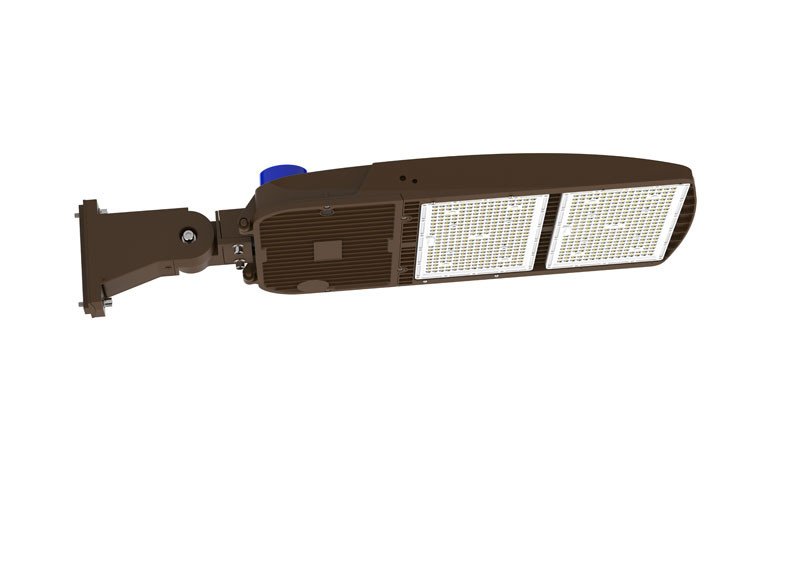
A 300W LED shoebox light produces 45,000 lumens—equivalent to a 1000W metal halide fixture—while consuming 70% less energy and lasting 2.5 times longer.
This comprehensive guide covers everything you need to know about selecting, installing, and optimizing LED shoebox lights for parking lots, streets, and large area illumination applications.
1. What is a LED Shoebox Light?
A LED shoebox light is a rectangular outdoor lighting fixture designed for area illumination in parking lots, streets, and large outdoor spaces. Named for its shoebox-like shape, this fixture typically mounts on poles via slip-fitter brackets and delivers directional light through Type II or Type III distribution patterns. Shoebox lights range from 100W to 500W, producing 15,000 to 75,000 lumens. The rectangular housing houses LED arrays, a driver, and thermal management components. Modern shoebox lights achieve 150+ lumens per watt efficacy, making them ideal replacements for 250W-1000W metal halide and high-pressure sodium fixtures. Key advantages include instant on/off operation, no warm-up time, superior color rendering, and 50,000+ hour lifespan.
- Rectangular fixture for parking lots and streets
- Mounts on poles via slip-fitter (2 3/8″ tenon)
- 100W-500W, 15,000-75,000 lumens
- 150+ lm/W efficacy
- Replaces 250W-1000W metal halide
2. Type II vs Type III Distribution: Which Do You Need?
Distribution pattern determines how light spreads from the fixture. Choosing the right pattern is critical for uniform illumination and minimizing light trespass. **Type II Distribution** produces a rectangular pattern with a width-to-length ratio of up to 1:1.5. Light extends forward and to the sides, making it ideal for narrow roadways, parking lanes, and walkways. Use Type II when fixture spacing is 2-3 times the mounting height. **Type III Distribution** creates a wider rectangular pattern with a width-to-length ratio of up to 1:2. It’s designed for larger parking lots and areas where fixtures are placed near one side. Use Type III when you need to illuminate a wider area from a perimeter position. **Decision Guide**: For standard parking lots with fixtures on poles in driving lanes, Type II provides optimal coverage. For perimeter lighting where fixtures mount on building edges or property lines, Type III distributes light further into the space. Many shoebox lights offer interchangeable lenses so you can select the distribution pattern during installation.
- Type II: Narrow pattern, parking lanes, 1:1.5 ratio
- Type III: Wide pattern, large lots, 1:2 ratio
- Type II for fixtures in driving lanes
- Type III for perimeter mounting
- Interchangeable lenses available
3. Wattage Selection: How Many Lumens Do You Need?
Proper wattage selection depends on area size, mounting height, required light level, and existing fixture spacing. **Parking Lots**: Most commercial parking lots require 5-10 foot-candles (50-100 lux) for customer safety and security. A 300W shoebox at 20-foot mounting height covers approximately 60×80 feet at 5 foot-candles. **Streets and Roadways**: Local streets typically need 0.5-1.5 foot-candles. Collector roads require 1.0-2.0 foot-candles. A 200W-300W shoebox on 25-30 foot poles with 100-150 foot spacing meets most requirements. **Wattage-to-Lumen Reference**: 100W = 15,000 lm (replaces 250W MH), 150W = 22,500 lm (replaces 400W MH), 200W = 30,000 lm (replaces 400W MH), 300W = 45,000 lm (replaces 1000W MH), 400W = 60,000 lm (large area coverage), 500W = 75,000 lm (high mast applications). **Spacing Rule**: For uniform coverage, space fixtures 3-4 times the mounting height apart. At 20-foot height, space 60-80 feet apart. Request a photometric layout for precise fixture count and placement.
- Parking lots: 5-10 fc, 300W covers 60×80 ft
- Streets: 0.5-2.0 fc per IESNA
- Spacing: 3-4x mounting height
- 300W replaces 1000W metal halide
- Get photometric layout for accuracy
4. Mounting Options and Installation
Shoebox lights offer several mounting configurations to suit different pole types and applications. **Slip-Fitter Mount**: The most common option—a cylindrical bracket that slides onto a 2 3/8″ (60mm) round pole tenon. Allows 15-30° tilt adjustment. Standard on most shoebox lights. **Trunnion/Yoke Mount**: A U-shaped bracket for flat surfaces or walls. Ideal for building perimeters and security lighting where pole mounting isn’t available. Adjustable angle for precise aiming. **Adjustable Arm**: An extension arm that positions the fixture further from the pole. Reduces shadowing and allows setback from traffic lanes. **Pole Mount Considerations**: Verify pole diameter matches the slip-fitter (2 3/8″ is standard). Check wind load ratings—the EPA (Effective Projected Area) of the fixture plus wind speed determines if the pole is adequate. For retrofit projects, existing poles may need reinforcement. **Electrical Connection**: Most shoebox lights have a junction box with 1/2″ or 3/4″ knockouts. Wire through the pole or use conduit. 120-277V models work with standard 120V or 277V circuits. 277-480V models require higher voltage infrastructure.
- Slip-fitter: 2 3/8″ round pole, most common
- Trunnion: Wall or flat surface mounting
- Check wind load and EPA ratings
- 120-277V or 277-480V options
- Junction box with standard knockouts
5. Energy Savings and ROI Calculation
LED shoebox lights deliver substantial energy savings compared to metal halide and high-pressure sodium fixtures. **Energy Savings Formula**: (Old watts – New watts) × Hours × 365 ÷ 1000 × Rate = Annual savings per fixture. **Example**: Replacing 1000W MH with 300W LED at 12 hours/day, $0.12/kWh: (1000 – 300) × 12 × 365 ÷ 1000 × $0.12 = $368/year savings per fixture. A 20-fixture parking lot saves $7,360 annually. **Additional Savings**: Reduced maintenance—no lamp replacements for 10+ years vs every 2 years for MH. No ballast failures. Lower HVAC load in enclosed structures. **Utility Rebates**: DLC-listed fixtures qualify for rebates in most utility territories. Typical rebates: $50-150 per fixture for parking lot lights. Contact your utility for current programs. **Payback Period**: At $368/year savings and $300-500 fixture cost, payback is 1-2 years. With rebates, payback can be under 12 months. For new construction, first cost is typically lower than MH due to fewer fixtures needed and smaller wire/breaker requirements.
- 300W LED saves $368/year vs 1000W MH
- 20 fixtures = $7,360/year savings
- Rebates: $50-150 per fixture
- Payback: 1-2 years, under 1 year with rebates
- No maintenance for 10+ years
6. Motion Sensors and Smart Controls
Adding motion sensors and controls can increase energy savings by 30-70% in applications with variable traffic patterns. **Microwave Motion Sensors**: Detect movement through Doppler radar. Work through plastic and glass, making them suitable for enclosed fixtures. Adjustable detection range (up to 40 feet), hold time (5 seconds to 30 minutes), and daylight threshold. Ideal for parking structures and areas with intermittent traffic. **Photocells**: Enable dusk-to-dawn automatic operation. Essential for outdoor applications to avoid wasting energy during daylight. Most shoebox lights have built-in photocell ports or offer photocell as an option. **0-10V Dimming**: Allows stepless dimming from 10% to 100%. Compatible with building automation systems and external controllers. Use for after-hours reduced lighting or to extend fixture life. **Surge Protection**: Recommended for areas with lightning or grid instability. A 10kV surge protection device (SPD) protects the driver and extends fixture life. **Smart Controllers**: Enable remote monitoring, scheduling, and dimming via cellular or LoRaWAN networks. Monitor energy use, detect failures, and optimize operations from a central dashboard.
- Motion sensors: 30-70% additional savings
- Microwave works through materials
- Photocells for dusk-to-dawn operation
- 0-10V dimming for building automation
- Surge protection in lightning-prone areas
Conclusion
LED shoebox lights provide efficient, long-lasting illumination for parking lots, streets, and large outdoor areas. By selecting the right wattage, distribution pattern, and controls, you can achieve 70% energy savings while improving light quality and reducing maintenance.