
LED Shoebox Light FAQ: Top 25 Questions Answered 2026
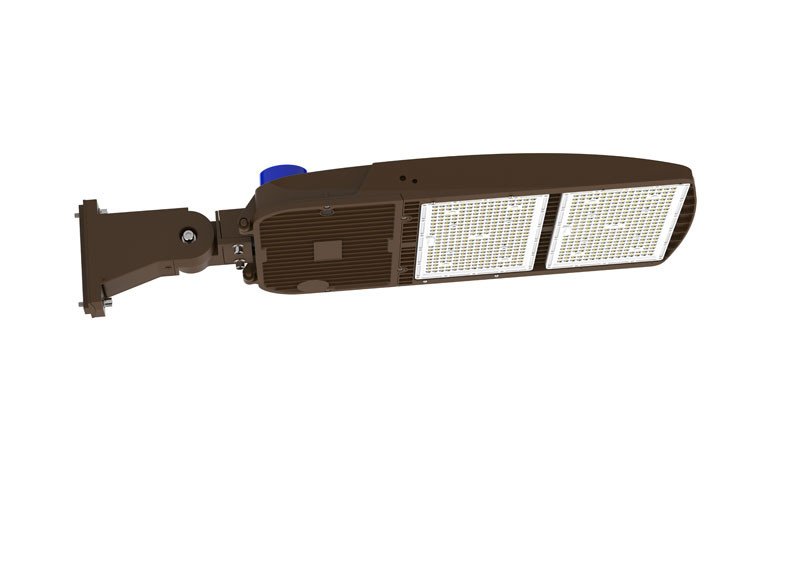
Expert answers to the most common questions about LED shoebox lights for parking lots, streets, and area lighting.
A: A LED shoebox light is a rectangular outdoor lighting fixture designed for parking lots, streets, and large area illumination. Named for its shoebox-like shape, it mounts on poles via slip-fitter brackets and provides directional light through Type II or Type III distribution patterns. Wattages range from 100W to 500W.
A: The fixture gets its name from its rectangular, box-like shape that resembles a shoebox. This form factor houses the LED array, driver, and thermal management components while providing a sleek, low-profile appearance on poles.
A: Most commercial parking lots use 200W-300W shoebox lights. A 300W fixture at 20-foot mounting height covers approximately 60×80 feet at 5 foot-candles. For smaller lots or lower mounting (15 feet), 150W-200W may suffice. Large lots with 25+ foot mounting may require 400W-500W. Get a photometric layout for precise sizing.
A: A quality 300W LED shoebox light produces 45,000 lumens at 150 lm/W efficacy. This is equivalent to a 1000W metal halide fixture which produces about 45,000-50,000 lumens initially (but degrades to 35,000 within 2 years).
A: Type II distribution produces a rectangular light pattern with a width-to-length ratio up to 1:1.5. It’s designed for narrow roadways, parking lanes, and walkways where fixtures are placed in the center of the illuminated area. Light extends forward and to both sides equally.
A: Type III distribution creates a wider rectangular pattern with a width-to-length ratio up to 1:2. It’s ideal for larger parking lots and areas where fixtures are placed at the perimeter. Light projects further into the space from the fixture location.
A: For standard parking lots with poles in driving lanes, Type II provides optimal uniform coverage. For perimeter lighting where fixtures mount on building edges or property boundaries, Type III distributes light further into the space. Many fixtures offer interchangeable lenses so you can select during installation.
A: For uniform coverage, space fixtures 3-4 times the mounting height apart. At 20 feet mounting height, space 60-80 feet apart. At 25 feet, space 75-100 feet apart. Exact spacing depends on required light level, distribution type, and fixture output—always get a photometric layout.
A: A slip-fitter is a cylindrical mounting bracket that slides onto a round pole tenon (typically 2 3/8″ or 60mm diameter). It’s the most common mounting for shoebox lights, allowing 15-30° tilt adjustment for precise aiming. Secure with set screws after positioning.
A: Most LED shoebox lights operate on 120-277V AC, covering standard 120V commercial and 277V industrial circuits. High-voltage models (277-480V) are available for large industrial and municipal installations. Always verify voltage compatibility before purchasing.
A: Yes! LED shoebox lights are ideal replacements for 250W-1000W metal halide fixtures. A 100W LED replaces 250W MH, 150W-200W LED replaces 400W MH, and 300W LED replaces 1000W MH. Benefits: 70% energy savings, instant on/off, 50,000+ hour life, no color shift, better cold-weather performance.
A: LED shoebox lights typically save 60-75% compared to metal halide. Replacing a 1000W MH with 300W LED running 12 hours/day saves about $368/year per fixture at $0.12/kWh. A 20-fixture parking lot saves over $7,000 annually. Additional savings from reduced maintenance and rebates.
A: Yes, DLC-listed LED shoebox lights qualify for rebates in most utility territories. Typical rebates range from $50-150 per fixture for parking lot lighting. Some utilities offer higher rebates for controls integration. Check with your local utility’s commercial efficiency program.
A: Quality LED shoebox lights are rated for 50,000-100,000 hours of operation. At 12 hours/day, that’s 11-23 years. Unlike metal halide, LEDs don’t fail suddenly—they gradually dim over time. L70 rating (70% of original output) is typically 50,000+ hours.
A: IP65 is standard for outdoor shoebox lights—dust-tight and protected against water jets. IP66 provides additional protection for areas with heavy rain or pressure washing. For coastal environments, look for corrosion-resistant finishes and IP66+ ratings.
A: Yes, many shoebox lights support microwave or PIR motion sensors. Microwave sensors detect movement through materials (ideal for enclosed structures) while PIR sensors work line-of-sight. Motion sensors can reduce energy use 30-70% in applications with variable traffic patterns.
A: A photocell is a light sensor that automatically turns fixtures on at dusk and off at dawn. For outdoor parking lot and street lighting, photocells are essential to avoid wasting energy during daylight. Most shoebox lights have built-in photocell ports or offer photocell as a factory option.
A: For North America: UL or ETL safety listing (required for code compliance) and DLC qualification (for utility rebates). For international: CE and RoHS compliance. Look for 5-year warranty minimum. For municipal projects, verify Buy American compliance if required.
A: Many LED shoebox lights support 0-10V dimming for integration with building automation systems. Dimming extends fixture life, reduces energy use during low-traffic periods, and enables flexible lighting levels. Not all fixtures are dimmable—verify before purchasing.
A: Minimal maintenance. Clean lenses annually with mild soap and water. Inspect seals and gaskets every 2-3 years. No lamp replacements for 10+ years. In coastal or industrial environments, check for corrosion annually. Most issues are driver-related and covered under warranty.
A: Yes, LED shoebox lights are widely used for local streets, collector roads, and alleys. Select Type II distribution for roadways. Verify compliance with IESNA RP-8 roadway lighting standards. For high-traffic arterial roads, consider dedicated LED street lights with Type V distribution.
A: 5000K (daylight) is most popular for parking lots—bright, clear illumination that enhances visibility and security camera performance. 4000K (neutral white) provides a softer appearance, suitable for retail centers with evening shopping. 3000K is generally too warm for large outdoor areas.
A: Surge protection devices (SPD) protect LED drivers from voltage spikes caused by lightning or grid switching. Recommended for all outdoor lighting in areas with lightning activity. A 10kV SPD is standard. In high-risk areas, 20kV protection provides additional safeguard.
A: Calculate: (Old watts – New watts) × Hours/year ÷ 1000 × Rate = Annual savings. Subtract rebate for net cost. Divide net cost by annual savings for payback years. Example: (1000-300) × 4,380 ÷ 1000 × $0.12 = $368/year. With $400 fixture and $100 rebate: $300 ÷ $368 = 0.8 years payback.
A: For recreational fields (tennis courts, small baseball fields), 400W-500W shoebox lights on 25-30 foot poles can provide adequate illumination. For competitive sports or larger fields, dedicated LED sports lighters with higher output and narrower beam angles are recommended.