
LED Flood Lights FAQ: Top 20 Questions Answered 2026
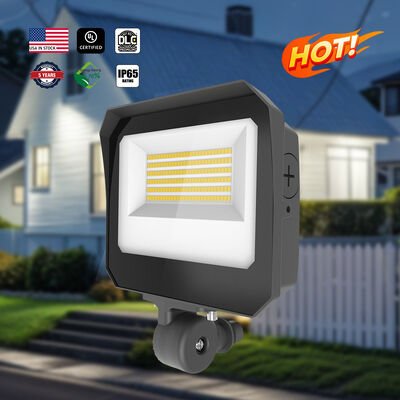
A: LED flood lights are directional outdoor lighting fixtures designed to illuminate large areas. They produce high-intensity light in a focused beam, making them ideal for building facades, parking lots, sports fields, and security lighting. Unlike area lights that emit 360°, flood lights can be aimed precisely where light is needed.
A: For small areas (under 5,000 sq ft), 100W-200W is usually sufficient. Medium areas (5,000-20,000 sq ft) need 200W-400W. Large areas (20,000+ sq ft) require 400W-1000W or multiple fixtures. A 300W LED flood light produces about 40,000-45,000 lumens, equivalent to a 1000W metal halide.
A: IP65 is the minimum for outdoor use—completely dust-tight and protected against water jets. IP66 is recommended for areas exposed to heavy rain or pressure washing. IP67 is necessary for flood-prone locations where temporary immersion may occur. Always verify the rating with a recognized testing lab.
A: 5000K-6000K is ideal for most commercial applications. It provides bright, daylight-like illumination that enhances visibility and security camera performance. 4000K is better for residential areas where harsh white light may cause complaints. Higher color temperatures improve security deterrence.
A: Beam angle determines throw distance. Narrow beam (15-30°) fixtures can illuminate effectively at 100+ feet for spotlighting. Wide beam (60-120°) fixtures cover larger areas closer to the fixture. A 300W narrow-beam flood light can light a flagpole from 200 feet away.
A: Yes! LED flood lights are the standard replacement for metal halide. A 150W LED can replace 400W metal halide, and 300W LED replaces 1000W metal halide. Benefits include 60-70% energy savings, instant-on, no warm-up, and 50,000+ hour lifespan vs 20,000 for metal halide.
A: Quality LED flood lights last 50,000-100,000 hours. At 12 hours daily operation, that’s 11-22 years. Unlike traditional bulbs, LEDs don’t fail suddenly—they gradually dim over time, giving advance warning. Proper heat dissipation is key to achieving rated lifespan.
A: Flood lights have wide beam angles (60-120°) for area illumination. Spot lights have narrow beams (10-30°) for focused lighting on specific objects. Flood lights cover more area with softer edges; spot lights produce intense, concentrated illumination on smaller targets.
A: Calculate required lumens: Area (sq ft) × Desired Foot-Candles. For a 10,000 sq ft parking lot needing 10 fc, you need 100,000 lumens. Using 300W fixtures (40,000 lm each), you need 2-3 fixtures. Add 10-20% for uniformity and overlap. Lighting software provides precise calculations.
A: Yes! LEDs actually perform better in cold temperatures. Unlike metal halide that requires warm-up time and may not start in extreme cold, LEDs turn on instantly at any temperature. This makes them ideal for cold storage exteriors and northern climates.
A: Narrow (15-30°): Long-distance spotlighting, flags, monuments. Medium (30-60°): Building facades, signage, medium-throw applications. Wide (60-120°): Parking lots, large area coverage, security perimeters. Match beam angle to throw distance and coverage needs.
A: Some LED flood lights support dimming with 0-10V dimmers. Check product specifications. Dimming reduces energy use and extends fixture life. Not all fixtures are dimmable—verify before purchasing if dimming is needed.
A: Common methods: Wall mount (use appropriate anchors), pole mount (slip fitter or trunnion), or ground/stake mount for landscape lighting. Use IP66 junction boxes, install surge protection, and ground all metal fixtures. For complex installations, hire a licensed electrician.
A: Commercial flood lights are larger (100W-1000W), produce more lumens, have higher IP ratings, and are built for 24/7 operation. Residential fixtures are smaller (10W-100W), designed for aesthetic lighting, and typically IP65 rated. Commercial fixtures cost more but last longer.
A: Minimal maintenance required. Clean lenses annually to maintain light output. Inspect seals and gaskets every 2-3 years. Check electrical connections periodically. No lamp replacements needed for 50,000+ hours. In harsh environments (coastal, industrial), more frequent inspection is advised.
A: Yes! 5000K-6000K LED flood lights match security camera sensitivity curves for optimal image quality. Instant-on capability means immediate illumination when motion is detected. Even, shadow-free coverage improves camera effectiveness. Consider motion sensor integration.
A: Quality commercial LED flood lights come with 5-10 year warranties. The warranty should cover the LED array, driver, and housing. Check terms for exclusions. Longer warranty indicates manufacturer confidence in product durability.
A: Some fixtures are rated for inverted mounting, but many are not. Check product specifications. Upside-down mounting can cause water accumulation and overheating. If inverted mounting is needed, choose fixtures specifically rated for it.
A: A 300W LED flood light running 10 hours daily consumes 3 kWh. At $0.12/kWh, that’s $0.36/day or $131/year. Compared to a 1000W metal halide equivalent ($438/year), you save $307 annually per fixture. ROI is typically 1-3 years.
A: UL or ETL listing for safety compliance. DLC certification for utility rebates. IP rating verified by a recognized lab. For Canada, CSA certification. FCC compliance for electromagnetic interference. Energy Star for additional efficiency verification.


