LED Bollard Light FAQ: Top 25 Questions Answered 2026
Expert answers to the most common questions about LED bollard lights for landscape and pathway lighting applications.
A: A LED bollard light is a short post-type outdoor lighting fixture, typically 600mm-1200mm tall, designed for pathway and landscape illumination. Named after marine bollards (ship mooring posts), these fixtures provide low-level lighting that guides pedestrians safely while adding architectural interest to outdoor spaces. Modern LED versions like the HAROLUX SS-BD Series produce 3600 lumens from just 24W.
A: Standard bollard heights: 600-800mm for decorative accent lighting, 800-1000mm for typical pathway illumination (most common), 1000-1200mm for large landscapes and wayfinding. Choose height based on coverage needed and visual proportions with surrounding architecture. Taller bollards cast light further but may create more glare.
A: Space bollard lights 3-4 times the mounting height. For a 1000mm bollard, space 3-4 meters apart for continuous illumination. For accent/pools of light effect, increase spacing to 5-8 meters. For wide pathways over 3 meters, stagger fixtures left and right for better coverage.
A: Pathway bollards typically produce 1000-5000 lumens. For pedestrian pathways, 2000-3000 lumens per fixture provides adequate visibility. For commercial spaces requiring higher light levels, 3000-5000 lumens is appropriate. The HAROLUX SS-BD Series delivers 3600 lumens, suitable for most commercial and municipal applications.
A: IP65 is the standard for quality outdoor bollard lights—completely dust-tight and protected against water jets. IP66 provides enhanced protection for areas with pressure washing. For coastal or flood-prone areas, consider IP67 or specify marine-grade construction.
A: Yes, but specify marine-grade construction. Standard powder-coated aluminum may corrode in salt spray environments within 2-3 years. Look for enhanced corrosion-resistant finishes, 316 stainless steel hardware, and sealed electrical compartments. IP66+ rating recommended.
A: 3000K warm white creates inviting atmosphere for hospitality and residential applications. 4000K neutral white suits commercial and public spaces. 5000K daylight provides maximum visibility for safety-critical areas. Many modern bollards offer selectable CCT to match requirements.
A: Three common methods: Surface mount (bolt-down base plate for concrete), ground stake (for soft ground like gardens), or recessed anchor (for new concrete pours). Most quality bollards include mounting hardware for surface installation. Underground conduit required for electrical supply.
A: For surface-mounted bollards on existing concrete, a properly secured base plate is sufficient. For new installations in soft ground, concrete footings prevent settling and tipping. Footing depth should be 300-600mm depending on soil conditions and frost line.
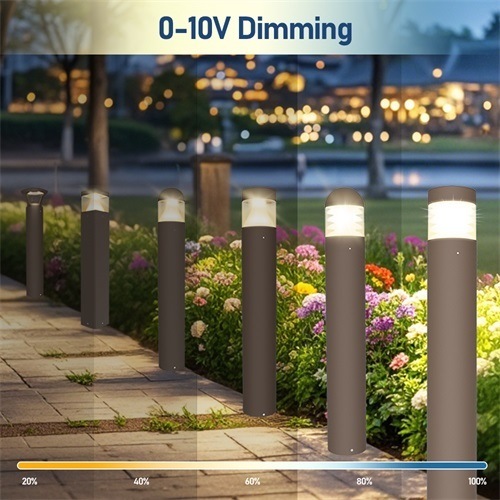
A: Some LED bollard lights support 0-10V dimming for integration with landscape lighting control systems. Standard fixtures operate on/off only. If dimming is required, specify this when ordering—retrofitting is typically not possible.
A: Quality LED bollard lights are rated for 50,000+ hours. At 8 hours per night operation, that’s over 17 years. Unlike traditional bulbs, LEDs gradually dim rather than fail suddenly, giving advance notice for replacement planning.
A: Minimal maintenance. Clean lenses annually with mild soap and water. Check seals and gaskets every 2-3 years. No lamp replacements for 10+ years. In harsh environments (coastal, industrial), inspect annually for corrosion and seal degradation.
A: Quality bollard lights feature die-cast aluminum or steel construction that withstands typical impact. Look for IK08+ impact rating for high-traffic public areas. Tamper-resistant hardware and sealed compartments protect electrical components.
A: Most commercial LED bollard lights operate on 120-277V AC for North American markets. Some models offer 120-347V for Canadian applications. Low-voltage (12V/24V) versions available for residential DIY installations using landscape transformers.
A: Bollard lights provide pathway illumination and area presence, but are not primary security lighting. For security applications, combine with motion-activated flood lights or integrate bollards with microwave sensors for responsive illumination.
A: Bollard lights are taller (600mm+) and provide 360° or wide distribution for area coverage. Path lights are shorter (300-500mm) and typically focus light downward in a narrower pattern. Bollards suit larger areas; path lights work for defined walkways.
A: Some models include built-in photocells for automatic dusk-to-dawn operation. Others offer photocell as an option. For centralized control systems, specify bollards without photocells to avoid conflicts. The HAROLUX SS-BD Series offers photocell as an optional feature.
A: Calculate pathway length divided by spacing distance, plus one. Example: 50-meter pathway with 4-meter spacing = 50 ÷ 4 = 12.5, round up to 13 fixtures. For complex layouts, request a photometric study that accounts for fixture output, mounting height, and required light levels.
A: For North America: UL or ETL safety listing (required for code compliance), DLC qualification (for utility rebates). For wet locations, verify wet location rating. CE and RoHS for international projects. IP rating should be independently verified.
A: Yes, some LED bollard lights offer integrated microwave or PIR motion sensors. Microwave sensors detect movement through materials and work well in enclosed spaces. PIR sensors require line-of-sight. Motion sensors reduce energy consumption in low-traffic areas.
A: Stock items ship within 1-2 weeks. Custom colors or heights require 4-8 weeks. Large project orders (100+ units) typically 6-10 weeks. Plan early for new construction projects—order fixtures during rough-in phase to ensure timely delivery.
A: Yes, manufacturers typically offer tiered pricing: 10-49 units at standard pricing, 50-99 units at 5-10% discount, 100+ units at 15-20% discount. Contact suppliers with project specifications for custom quotations.
A: Custom options include height (600mm-1500mm+), color (custom RAL matching), engraving or logo branding, special optical distributions, and unique head designs. Minimum order quantities apply for custom items, typically 20-50 units.
A: Match the design style to your architecture: modern/minimalist buildings suit clean cylinders or squares; traditional styles pair with decorative or fluted designs; transitional architecture accommodates both. Consider the fixture as a daytime visual element, not just nighttime lighting.
A: Quality LED bollard lights come with 5-year warranties. Premium products may offer extended warranties up to 7-10 years. Verify warranty covers both LED array and driver, and check terms for environmental exclusions (coastal, industrial).
产品规格参考