
LED Wall Pack Lights FAQ: 25 Common Questions Answered
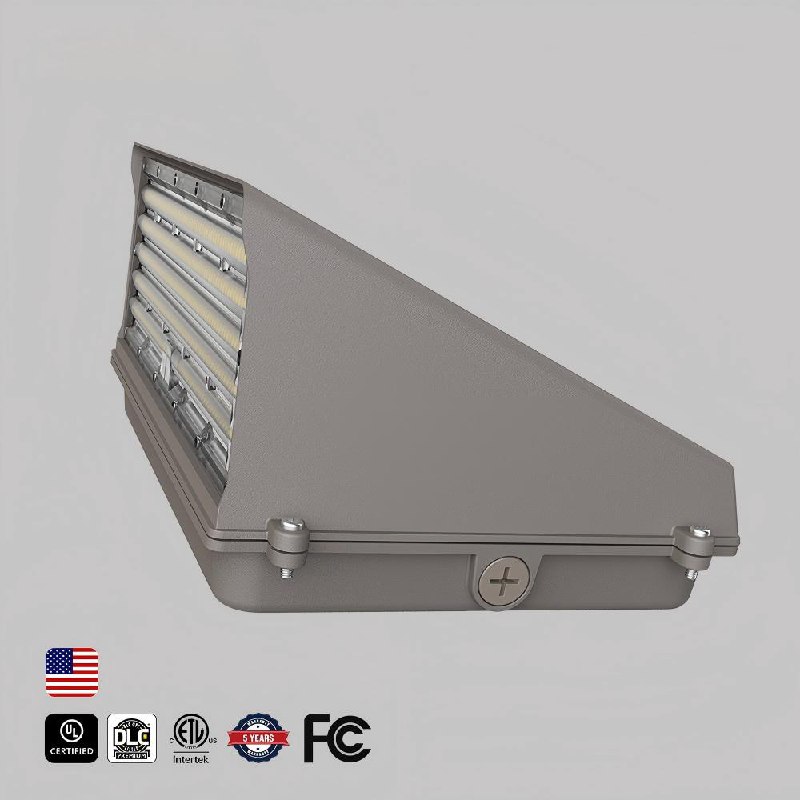
LED Wall Pack Frequently Asked Questions
What is an LED wall pack light?
An LED wall pack light is an outdoor lighting fixture designed to be mounted on building walls. It uses LED technology to provide efficient illumination for building perimeters, parking areas, loading docks, and security applications. LED wall packs typically replace older metal halide or high-pressure sodium fixtures.
How many watts do I need for a wall pack?
Wall pack wattage depends on mounting height and application. For 10-12 ft mounting, use 20-40W. For 12-16 ft, use 40-60W. For 16-24 ft, use 60-100W. For heights above 24 ft, consider 100-120W fixtures. Higher mounting requires more wattage to achieve the same ground-level illumination.
What is the difference between full cutoff and forward throw wall packs?
Full cutoff wall packs direct all light downward at or below 90 degrees, preventing light pollution and trespass. They’re required in dark-sky communities. Forward throw wall packs project light further from the building at angles above 90 degrees, providing wider coverage for parking areas and large perimeters.
How long do LED wall packs last?
Quality LED wall packs have a rated lifespan of 50,000+ hours. At 12 hours of daily operation, this translates to over 11 years of service. Unlike metal halide lamps that gradually dim over time, LEDs maintain consistent output throughout their lifespan.
Are LED wall packs waterproof?
Most commercial LED wall packs are rated IP65 or higher, meaning they’re dust-tight and protected against water jets. This makes them suitable for outdoor use in all weather conditions, including heavy rain, snow, and coastal environments with salt spray.
What color temperature should I choose?
For most commercial applications, 4000K (neutral white) provides balanced illumination. 5000K (daylight) offers higher visibility for security applications. 3000K (warm white) is suitable for residential-adjacent properties where light trespass is a concern.
Can LED wall packs be used with photocells?
Yes, most LED wall packs are compatible with photocells for automatic dusk-to-dawn operation. Many models include built-in photocells or have knockouts for external sensor installation. Photocell control can reduce energy consumption by ensuring lights only operate when needed.
How do I calculate energy savings from LED wall packs?
LED wall packs typically save 60-70% compared to metal halide fixtures. A 100W LED replacing a 250W metal halide saves approximately $157 per year at $0.12/kWh with 12-hour daily operation. Payback periods are typically 1-2 years for commercial installations.
What is a selectable CCT wall pack?
Selectable CCT wall packs allow you to choose between multiple color temperatures (typically 3000K, 4000K, 5000K) using an internal switch. This flexibility lets one fixture model serve different applications without ordering separate SKUs.
Do LED wall packs require maintenance?
LED wall packs require minimal maintenance compared to traditional fixtures. There are no bulbs to replace, and the solid-state construction is highly reliable. Occasional cleaning of the lens may be needed in dusty environments. Most manufacturers offer 5-year warranties.
What voltage do LED wall packs use?
Most commercial LED wall packs operate on 120-277V input, making them compatible with standard commercial electrical systems. Some models are also available in 347V or 480V for industrial applications. Always verify voltage compatibility before installation.
Can LED wall packs be dimmed?
Some LED wall pack models are dimmable using 0-10V dimming protocols. Dimming capability is useful for applications where light levels can be reduced during low-activity periods to save energy. Not all models support dimming – check specifications before purchasing.
What is the beam angle of a wall pack?
LED wall packs typically have beam angles of 100-120 degrees horizontal and 60-90 degrees vertical, creating a Type IV distribution pattern. This provides a forward-throw pattern ideal for illuminating areas away from the building wall.
How high should wall packs be mounted?
Wall packs are typically mounted at 10-25 ft above ground level. Lower mounting (10-15 ft) works for entrances and small areas. Medium mounting (15-20 ft) suits loading docks and garages. Higher mounting (20-25 ft) is used for building perimeters and parking areas.
What is the difference between LED wall packs and flood lights?
Wall packs are designed specifically for wall mounting with a fixed aiming angle, while flood lights offer adjustable aiming and can be mounted on poles or walls. Wall packs typically have a wider, more uniform distribution pattern for perimeter lighting, while flood lights provide focused, directional illumination.
Are LED wall packs dark-sky compliant?
Full cutoff LED wall packs are dark-sky compliant as they direct all light downward, preventing light pollution. Look for IDA (International Dark-Sky Association) certification or full cutoff designation if dark-sky compliance is required in your area.
Can LED wall packs be used in cold climates?
Yes, LED wall packs perform well in cold climates. Most are rated for operation down to -40°C (-40°F). Unlike fluorescent lights that lose efficiency in cold temperatures, LEDs actually perform slightly better in cooler conditions.
What certifications should I look for?
For commercial applications, look for UL or ETL listing for safety, DLC (DesignLights Consortium) qualification for utility rebates, and IP65 or higher for weather resistance. CE and RoHS certifications indicate compliance with European standards.
How do I choose between wall pack models?
Consider: (1) Required illumination level and mounting height, (2) Full cutoff vs. forward throw optics, (3) Energy efficiency (LM/W), (4) Color temperature needs, (5) Physical size and aesthetics, (6) Certifications required, (7) Budget and warranty.
Can wall packs be used for security camera lighting?
Yes, wall packs provide excellent illumination for security cameras. Use 5000K color temperature for best camera performance and facial recognition. Ensure even coverage without harsh shadows. Consider motion sensor integration for energy savings and to alert security when activity is detected.
What is the IP rating for outdoor wall packs?
IP65 is the minimum recommended rating for outdoor wall packs, providing dust-tight protection and resistance to water jets. IP66 and IP67 ratings offer even higher protection against heavy rain and temporary submersion, suitable for extreme weather environments.
How far apart should wall packs be spaced?
Space wall packs 1.5-2 times the mounting height apart. For example, at 15 ft mounting height, space fixtures 22-30 ft apart. Adjust spacing based on desired light levels and uniformity requirements. Overlap beam patterns by 20% for even coverage.
Can I retrofit existing wall pack housings with LED?
LED retrofit kits are available for converting existing wall pack housings to LED. These kits include an LED array and driver that fit into the existing housing. However, new LED wall packs often provide better thermal management and longer lifespan than retrofits.
What warranty do LED wall packs have?
Quality commercial LED wall packs typically come with 5-year warranties from reputable manufacturers. Some premium models offer 7-10 year warranties. Check warranty terms carefully – they may vary based on operating hours and environmental conditions.
Where can I buy commercial LED wall packs?
Commercial LED wall packs are available from lighting distributors, electrical wholesalers, and directly from manufacturers like HAROLUX. For commercial projects, contact HAROLUX for factory-direct pricing and technical support.
Related Products
- LED Wall Pack SS-WK08 (140LM/W)
- LED Wall Pack SS-WK07 (Full Cutoff)
- LED Wall Pack SS-WK06
- LED Slim Wall Pack
Published: March 2026


