
LED Linear Strip Light FAQ: Top 25 Questions Answered 2026
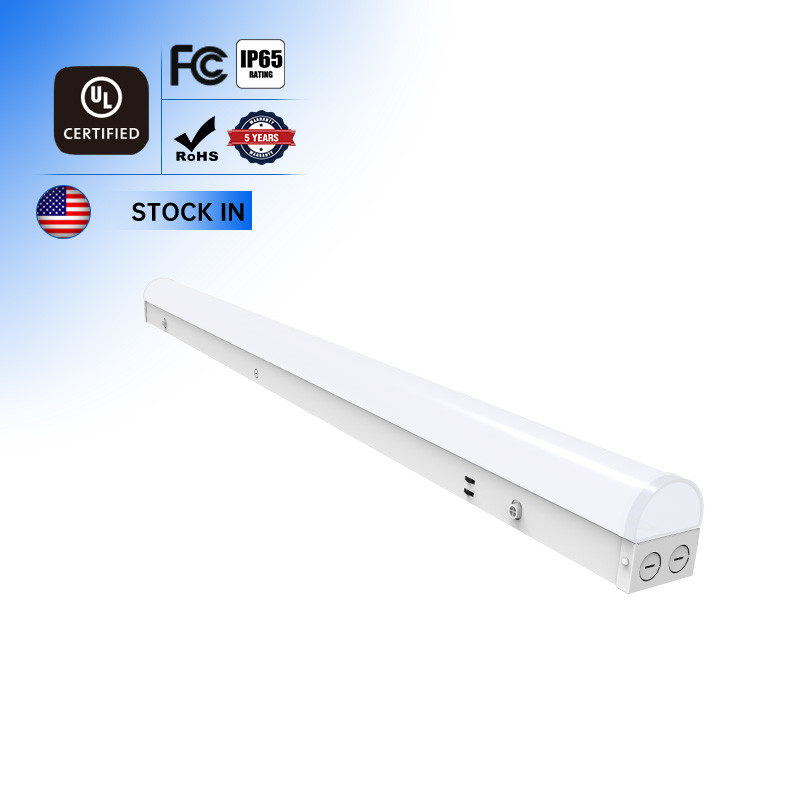
Everything you need to know about LED linear strip lights, answered in one place. This FAQ covers the 25 most common questions from contractors, facility managers, and business owners.
📋 General Questions
1. What is an LED linear strip light?
An LED linear strip light is a long, narrow fixture with integrated LED chips. Unlike fluorescent strips that use replaceable tubes and ballasts, LED strips have the light source built into the housing, providing higher efficiency and longer life.
2. How long do LED linear strip lights last?
Quality LED strip lights like the SS-SP05 series are rated for 50,000+ hours of operation. At 12 hours per day usage, that’s over 11 years of maintenance-free lighting.
3. Are LED strip lights better than fluorescent?
Yes, in nearly every application. LED strips consume 40-60% less energy, last 2-3x longer, provide instant start with no flicker, and require zero maintenance. They also eliminate mercury disposal concerns.
4. Can LED strip lights replace fluorescent fixtures?
Two options exist: retrofit strips that install into existing fluorescent housings, or new LED strips that replace the entire fixture. Retrofit is faster and cheaper; new fixtures offer more features and better aesthetics.
5. What does “selectable wattage” mean?
Selectable wattage fixtures have an internal switch that lets you choose between 3 power levels. For example, the SS-SP05-4 (4ft model) offers 40W/50W/64W settings, allowing one fixture to meet different brightness requirements.
📐 Sizing & Selection
6. What sizes do LED strip lights come in?
Common sizes are 2ft, 4ft, and 8ft lengths. The SS-SP05 series offers all three to match different ceiling heights and application needs.
| Size | Best Ceiling Height | Typical Application |
|---|---|---|
| 2ft | 8-12 ft | Narrow aisles, under-shelf |
| 4ft | 10-16 ft | Standard commercial |
| 8ft | 14-20 ft | Warehouse, industrial |
7. How many LED strip lights do I need?
Calculate based on desired foot-candles (FC) and room size:
- Warehouses: 20-30 FC, 8ft spacing for 4ft fixtures at 14ft ceiling
- Retail: 30-50 FC, 6ft spacing for 4ft fixtures at 12ft ceiling
- Offices: 30-50 FC, 8ft spacing for 4ft fixtures at 9ft ceiling
8. What color temperature should I choose?
Match color temperature to your application:
- 3500K (Warm White) – Retail, hospitality, healthcare waiting areas
- 4000K (Neutral White) – Offices, schools, general commercial
- 5000K (Daylight) – Warehouses, industrial, garages, outdoor areas
9. What’s the difference between 2ft, 4ft, and 8ft LED strips?
The main difference is coverage area and recommended ceiling height. 2ft covers approximately 4×4ft area at 10ft ceiling. 4ft covers 6×6ft area at 14ft ceiling. 8ft covers 8×8ft area at 18ft ceiling.
10. Can I use 8ft strips in a 4ft grid ceiling?
Not directly. 4ft grid ceilings require 4ft fixtures. However, you can mount 8ft strips perpendicular to the grid, or use suspended mounting that bypasses the grid entirely.
⚡ Installation & Electrical
11. How do I install LED linear strip lights?
Three mounting options:
- Surface mount: Screw brackets to ceiling, snap fixture in place
- Suspended: Hang with chains or cables from ceiling
- Wall mount: Attach vertically for cove or perimeter lighting
12. Do LED strip lights need a ballast?
No. LED strips use built-in LED drivers. Never connect LED fixtures to existing fluorescent ballasts—this will damage the LEDs and void the warranty.
13. What voltage do LED strip lights use?
Most commercial LED strips accept AC120-277V input, covering standard 120V and 277V commercial circuits. Always verify voltage compatibility before installation.
14. Can LED strip lights be dimmed?
Yes, if equipped with 0-10V dimming. The SS-SP05 series includes 0-10V dimming as standard, compatible with most commercial dimmers and lighting control systems.
15. How do I wire 0-10V dimming?
0-10V dimming requires two additional wires (typically purple and gray) connected to a compatible dimmer or control system. These wires carry the dimming signal separate from power.
💡 Performance & Efficiency
16. How much energy do LED strip lights save?
LED strips typically save 40-60% compared to fluorescent equivalents. A 40W LED strip produces similar light to a 40W fluorescent tube plus ballast, but at lower actual wattage when using selectable settings.
17. What is LM/W efficacy?
Lumens per watt (LM/W) measures how efficiently a fixture converts electricity to light. Higher is better. The SS-SP05 series delivers 130-150 LM/W, compared to 80-100 LM/W for typical fluorescent systems.
18. Do LED strip lights produce heat?
LEDs produce less heat than fluorescent or incandescent lighting, but they still generate some heat. Quality fixtures include aluminum heat sinks to dissipate heat and extend LED life.
19. Can LED strip lights be used in cold environments?
Yes. Unlike fluorescent tubes that struggle to start in cold temperatures, LEDs perform well in cold environments. They’re actually more efficient in cooler temperatures.
20. What is CRI and why does it matter?
Color Rendering Index (CRI) measures how accurately a light source reveals colors. CRI >80 is standard for commercial applications. Higher CRI (>90) is preferred for retail, art galleries, and color-critical work.
🔧 Maintenance & Troubleshooting
21. Do LED strip lights need maintenance?
Virtually none. Quality LED strips are rated for 50,000+ hours with no lamp changes or ballast replacements. Occasional cleaning to remove dust is all that’s needed.
22. Why won’t my LED strip light turn on?
Check these common issues:
- Power is off at the breaker
- Wiring connections are loose
- Dimmer is set to minimum (try adjusting)
- Driver failure (rare, covered by warranty)
23. Can I repair a failed LED strip?
Generally no. LED strips are integrated units—if the driver or LEDs fail, the entire fixture needs replacement. However, with 50,000+ hour lifespan, this should not occur for 10+ years.
24. What voids the LED strip warranty?
Common warranty voids include:
- Connecting to incompatible voltage
- Using with fluorescent ballast
- Physical damage from improper handling
- Modifications to the fixture
- Installation in environments outside rated specifications
25. How do I dispose of LED strip lights?
LEDs contain no mercury, unlike fluorescent tubes. They can be recycled as electronic waste. Check with local recycling facilities for proper disposal methods.
📊 Quick Reference Chart
| Question | Answer |
|---|---|
| Lifespan | 50,000+ hours |
| Energy savings | 40-60% vs fluorescent |
| Standard sizes | 2ft, 4ft, 8ft |
| Color temps | 3500K, 4000K, 5000K |
| Voltage | AC120-277V |
| Dimming | 0-10V standard |
| Warranty | 5 years |
| Certifications | UL, ETL, DLC, CE |
Related Resources
Last updated: March 2026